


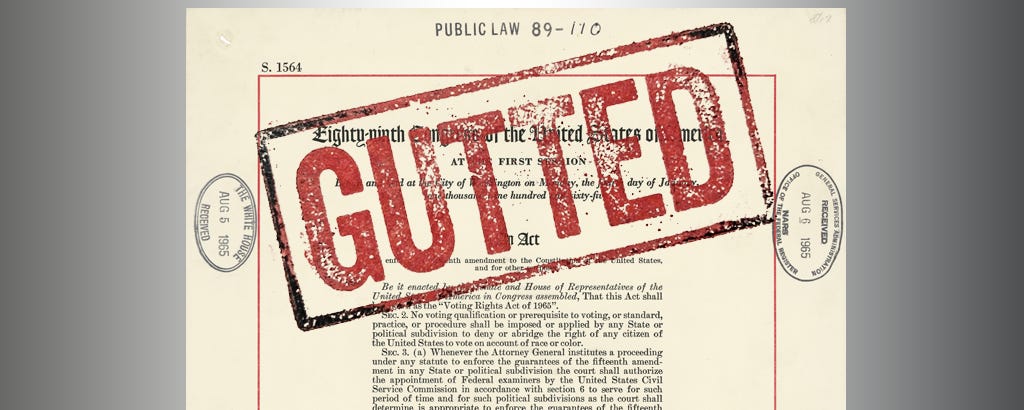
Ralph welcomes back Adolph Reed, Professor Emeritus of political science at the University of Pennsylvania and Distinguished Visiting Professor at Mount Holyoke College to discuss the latest Supreme Court decision gutting the Voting Rights Act. Then, Ralph and our resident constitutional scholar, Bruce Fein, talk about what ordinary citizens can do to pressure their reps to impeach Donald Trump.

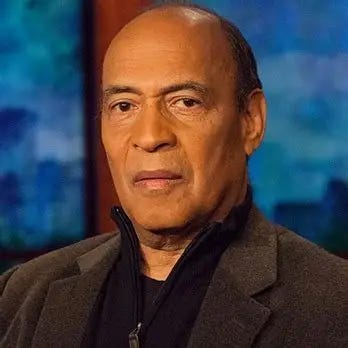
Adolph Reed is Professor Emeritus of political science at the University of Pennsylvania and Distinguished Visiting Professor at Mount Holyoke College. His most recent books are The South: Jim Crow and Its Afterlives, No Politics but Class Politics (co-authored with Walter Benn Michaels), and Black Studies, Cultural Politics, and the Evasion of Inequality: The Farce this Time (co-authored with Kenneth W. Warren).
I think the issues are a lot more complex than they seem to be or than seems to be the way that they are represented in the debate [over the Voting Rights Act]…To cut straight to the political case, I think there’s a distinction between the Act’s guarantee that black citizens and others (where pertinent) who live in areas where there’s been a history of suppression of the right to vote have the support of the federal government to make certain that Black voters have the ability to vote for and to elect candidates of their choosing. Which is not the same thing as a right of Black individuals to be elected to office. And I think that’s one of the confusions that characterizes, frankly, both sides of the debate at this point. And I think that’s definitely something that needs to be clarified.
Adolph Reed
Some of my friends and I have been talking about this, and have been bouncing this idea back and forth since, frankly, even before the court handed down the [Louisiana v Callais] decision. In thinking about developments in black politics across the board, the idea that all that Black voters are supposed to get out of politics is the representation of people who look like them and share in the same racial identification has also fueled backward turns. Like how all of a sudden the biggest issue in Black American politics supposedly had become the racial wealth gap, which boils down to a complaint that rich Black people aren’t as rich as rich white people are. So, yeah, shaking up or reshuffling the deck for how we might begin to try to determine the stakes of Black Americans’ engagement in national politics is something that needs to happen. No matter what brings it about.
Adolph Reed

Bruce Fein is a Constitutional scholar and an expert on international law. Mr. Fein was Associate Deputy Attorney General under Ronald Reagan and he is the author of Constitutional Peril: The Life and Death Struggle for Our Constitution and Democracy, and American Empire: Before the Fall.
My website is www.lawofficesofbrucefein.com and my email address is Bruce@feinpoints.com. And I’ll respond and give you guidance as to how you can help be part of this effort to impeach and remove by far the most dangerous President in the history of the United States. And he’s most dangerous to the world as well.
Bruce Fein
News 5/8/26
Our top story this week comes to us from the Bulwark, which reports that dissatisfaction with Democratic National Committee Chair Ken Martin is reaching a fever pitch. Martin has faced criticism over the course of his tenure for reneging on his promise to release an autopsy on the 2024 presidential campaign and for his decidedly lackluster fundraising efforts. The DNC has reportedly “spent more money than it has raised” and “has more debt than cash on hand,” while the Republican National Committee enjoys a “roughly seven-to-one money advantage.” According to this report, high-level DNC members are now privately discussing ousting Martin, only tabling these discussions “after members failed to identify an alternative candidate willing to step into the role.” Martin’s failures have even led Democrats to openly wonder “whether the 178-year-old committee should even exist anymore.” Martin was elected DNC Chair last year, beating out Wisconsin Democratic Party chair Ben Wikler, who helped rebuild the party and raise tremendous amounts of money in that critical swing state.
Speaking of money in politics, this week POLITICO released a damning report on End Citizens United, the good-government focused 501(c)(4) that has in past years been a “fundraising behemoth” but has now faded nearly into complete irrelevancy. The issues highlighted in this piece will be familiar to many who have worked in this world. Despite raising $14.8 million, the group’s PAC arm is burning through the money more quickly than it can raise it, having just $324,000 on hand at the end of March. What are they spending the money on? According to POLITICO, about $650,000 has gone to candidates and party groups and about the same amount has been bundled. Meanwhile, payments to fundraising firms have eaten up an astonishing $5.3 million. This is just another case of Democratic Party aligned consulting firms run amok and growing fat off of small dollar donations.
Another disappointing story comes to us from the Teamsters. According to Bloomberg, the union has forfeited a hard-won union foothold – the first ever unionized Chipotle – following three years of battling the company and failing to secure a contract. A Teamsters local president said in an email to the National Labor Relations Board that the union “officially withdraws and disclaims interest” at the Lansing, Michigan location. Legally speaking, this means the company will no longer be “required to recognize or negotiate with the union.” The employees of this location voted to unionize in 2022 by a margin of 11-to-3. Chipotle corporate has been decried for seeking to bust this union, with Biden NLRB General Counsel Jennifer Abruzzo accusing them of employing illegal anti-union tactics like “withholding raises from the store’s staff and telling workers that the union was keeping their pay frozen…[and punishing] a pro-union employee to discourage activism.” However, it was the Teamsters themselves who ultimately gave up, paving the way for the demise of the workers’ heroic stand against corporate power. As the saying goes, with friends like these.
In more positive political news, during the Washington DC mayoral debate last week, the Washington Post reports democratic socialist mayoral hopeful Janeese Lewis George seemed to endorse the idea of opening municipal grocery stores in DC food deserts, including the impoverished and majority Black Wards 7 and 8. Asked about this topic, Councilmember Lewis George committed to bringing at least one more grocery store to Ward 7 and at least two more to Ward 8, noting that she would seek to shore up investor confidence with public dollars. If private options do not materialize however, she vowed that “we will work towards” a publicly-owned store. Municipally-owned grocery stores were a much publicized part of the Zohran Mamdani campaign platform and, if Lewis George is elected, his success or failure in carrying out that pledge is sure to impact her decision making on this issue.
Meanwhile, in media news, the New York Times reports Lupa Systems – the private holding company representing the interests of James Murdoch, son of conservative media mogul Rupert Murdoch – is “in talks to acquire major parts of Vox Media.” Vox, founded in the 2010s by journalists Ezra Klein, Matt Yglesias, and Melissa Bell, now owns major media properties including New York magazine, the Verge, Eater and a podcast network featuring Kara Swisher and others. Murdoch, through Lupa, owns a “majority stake in Tribeca Enterprises, the parent company of the Tribeca Film Festival.” Additionally, the Times notes that Quadrivium, the foundation founded by Mr. Murdoch and his wife, Kathryn, has financial interests in “The 19th, a nonprofit newsroom focused on gender and politics, and The Bulwark, a so-called ‘Never Trump’ digital media company.” James Murdoch, along with his sister Elisabeth, are seen as far more liberal than the Murdoch patriarch and his other son, Lachlan, who together successfully ousted the other family members from control of the family trust in a recent legal battle.
Turning to international news, yet another deadlocked presidential election in Peru is looming. A new Ipsos poll, taken near the end of April, shows an exact 50-50 split between the two candidates in the runoff: the left-wing member of Congress Roberto Sánchez and Keiko Fujimori, daughter of former Peruvian dictator Alberto Fujimori. This election was always going to be close – Peruvian politics have been deadlocked for years, resulting in ultra-narrow presidential victories frequently followed by impeachments. Fujimori has been a runoff candidate in every presidential election going back to 2011, losing each by extremely narrow margins. Most recently, she lost to Pedro Castillo by a margin of 50.13% to 49.87% in 2021. Castillo however was thwarted by, and ultimately ousted by, the Congress. The runoff will be held on June 7th.
In India, the Left suffered catastrophic defeats in this week’s state elections, Al Jazeera reports. The state of Kerala – “the first in the world to have a democratically elected communist government” and “the last state in India where communists were in power” – will now be led by the United Democratic Front, a coalition headed by the Congress party, which won over 100 out of 140 seats. The Left bloc will likely capture around 35 seats. Beyond Kerala however, the Left has seen setbacks throughout the country, with no state now being ruled by the Left for the first time since 1977 and the national parliamentary Left bloc declining from 62 in the 2004 election to just eight seats today. Different factors are cited for the general decline of the Left in India, including an inability to adapt Marxist analysis to non class-related issues in the country, such as caste and gender, as well as the decline of industrial trade unions and a general trend towards Right-wing Hindu nationalism. Hopefully, the Left will take this electoral rout as an opportunity to rebuild itself into a viable force for 21st century Indian politics.
Turning to East Asia, the Financial Times reports North Korea has subtly revised its constitution to drop references to reunification of the two Koreas. Specifically, the new text reads “the territory of the Democratic People’s Republic of Korea includes the territory bordering the People’s Republic of China and the Russian Federation to the north and the Republic of Korea to the south, and the territorial sea and airspace established on it”. In acknowledging the existence of the Republic of Korea, more commonly known as South Korea, experts see a move away from the long-held North Korean contention that the peninsula is a single country illegally partitioned. The revision was “disclosed by an academic at a press conference hosted by the South Korean Ministry of Unification on Wednesday.” Though this article notes that “North Korea has not made any comment on the revised constitution and the source of the text revealed by the unification ministry was not disclosed,” it highlights that Kim Jong-un has increasingly moved in this direction in recent years, renaming Tongil (“reunification”) metro station in Pyongyang and dismantling an Arch of Reunification monument.
Our last two stories have to do with the People’s Republic of China. First, Reuters reports China’s Commerce Ministry has issued an injunction to “block U.S. sanctions imposed on five Chinese refiners accused of buying Iranian oil.” Hengli Petrochemical, one of the five small “teapot” refineries primarily located in China’s Shandong province, was slapped with sanctions last month, when the Trump administration accused the company of purchasing billions of dollars in Iranian oil. The other four have been sanctioned since last year. However, the Ministry now argues that the sanctions violate “international law and the basic norms of international relations,” and with the injunction in place, “the United States cannot recognize, implement, or comply with the sanctions imposed on the aforementioned five Chinese companies.” This is perhaps the most significant challenge to the American-led international sanctions regime in decades and whatever reaction issues from the U.S. will surely inform other states on just how far they can go in flouting such sanctions.
Finally, in a stunning legal decision, Fortune reports Chinese courts have ruled that “companies cannot terminate employees just to replace them with artificial intelligence systems.” The case in question hinged on whether a tech firm in eastern China had acted illegally when firing one of its workers, a “quality assurance professional…identified only as Zhou” after he “refused to take a demotion” and a 40% pay cut, when his job was automated by AI. The court found that the termination did not meet established standards, such as business downsizing or operational difficulties, and the court separately stated that “Companies cannot unilaterally lay off employees or cut salaries due to technological progress.” This stunning legal victory for workers in the face of challenges by technology is bittersweet – heartening in that it’s happening at all, yet at the same time depressing because it is almost impossible to imagine an equivalent worker protection regime being implemented in the United States.
This has been Francesco DeSantis, with In Case You Haven’t Heard.


