

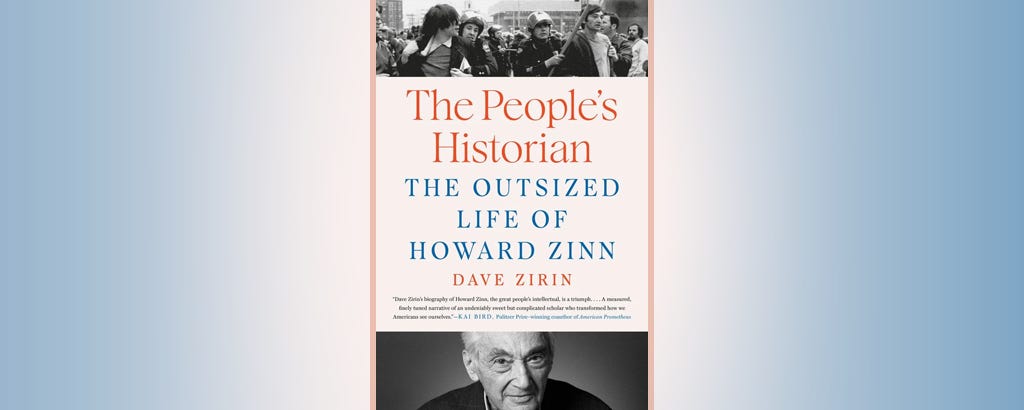
Ralph welcomes sportswriter Dave Zirin to talk about his new book, "The People's Historian: The Outsized Life of Howard Zinn." Then Ralph speaks to labor activist Gene Bruskin about their upcoming Labor Day event at Busboys and Poets in DC, "Galvanizing Labor Day for a Workers’ Compact."


Dave Zirin is the sports editor for The Nation, a columnist for the Progressive, and the author of eight books on the politics of sports, including What’s My Name, Fool?: Sports and Resistance in the United States and A People’s History of Sports in the United States. His new book is The People’s Historian: The Outsized Life of Howard Zinn.
There’s a despondency that exists now, I believe, among people who are also very angry about the state of our politics. And the thing that Howard always insisted upon—he was an activist who happened to be a historian, not a historian who was an activist. And that doesn’t denigrate his incredible skills as a historian, it just says where his priorities were in his time on this planet. And one of the things that Howard believed so strongly is that the movements themselves needed to have a strong sense of history. The movements needed to know that we live in a time of great ups and downs.
Dave Zirin
People did step up to create the Zinn Education Project. And every book event I’m doing, I’m showing up with copies of their materials and they usually have somebody on the ground doing the organizing at the event. And at the very least, we’re helping it be a little bit sticky. You know what I’m saying? Like, it’s not just a book event. It’s not just celebrating Howard. But it’s also something that allows us to be able to make it matter in a way that it otherwise would not—because it’s not just about selling books, it really is about building a movement.
Dave Zirin
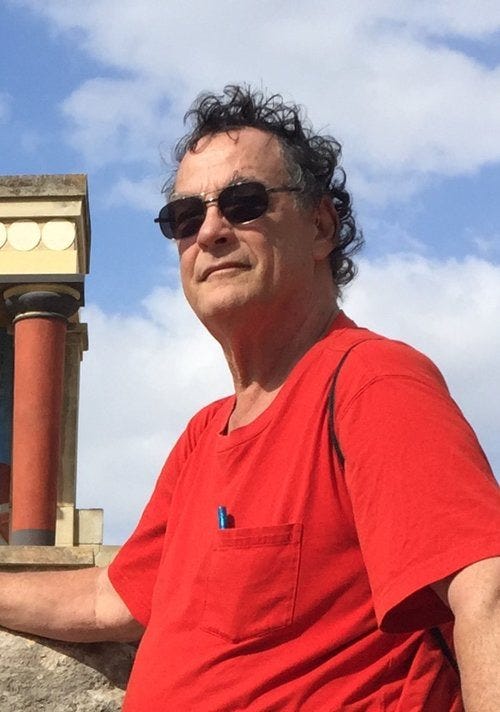
Gene Bruskin is a veteran of the labor movement as a local union president, an organizer, and campaign coordinator for numerous local and national unions. He has done extensive international labor solidarity work, including with Iraqi workers and unions, and is a founder of US Labor Against the War.
What we’re breaking through here now (and partly this has been the definition of this resistance movement) it’s workers versus billionaires. And I think the labor movement in general coming out of World War II has been captured by this mythology that “What’s good for General Electric is good for the nation.” And the more the economy “prospers,” the more it’s good for everybody. And it turns out that that’s not really the case, because we don’t have that kind of equality. And also what’s in the national interest in terms of our foreign policy is not in the interest of the average working class person. A lot of that stuff is being challenged and reversed—not enough, but it’s forcing some of the more moderate forces to the left, just as we’re seeing in some of these Senate and House elections.
Gene Bruskin
I think this is a really important moment for Labor Day because Labor Day, among other things, is generally the kickoff for whatever elections are happening in November. And it’s going to be that on steroids this year. But I think the important thing is that, of course, we want to throw out a bunch of these Neanderthal Republicans in the House and Senate. But it’s not just a matter of restoring a Democratic majority in the House and Senate. The question is: to what end? And what is on the agenda of a Democratic-majority Congress at this minute? What is the vision that we have for our future that we have to be fighting for? … We have to change this whole climate so that people have some kind of hope, some kind of vision for what we want and what we deserve. And the same old, same old, whether it’s a Democratic Congress or not, is not acceptable anymore.
Gene Bruskin
Galvanizing Labor Day for a Workers’ Compact (Sep 7, 2026 2:00 pm ET): Busboys and Poets and Ralph Nader present Galvanizing Labor Day for a Workers’ Compact, a discussion of how unions can maximize the impact of Labor Day to mobilize workers and voters ahead of the 2026 midterm elections and afterwards. (Event is in-person @ Busboys and Poets 14th & V + Livestreamed. Free and open to all, but registration is required.)
News 9/4/26
Our top story this week is the neo-colonial oil extraction deal that has been struck between the Trump administration and the government of Delcy Rodríguez in Venezuela. This government has been running the country under the barrel of a gun since Trump sent Delta Force to kidnap President Nicolás Maduro from his home in the Bolivarian Republic in January. According to the BBC, the new deal “grants a US-led company 100-year concessions over 17 oilfields in Venezuela, amounting to a staggering 65 billion barrels of crude,” or over one-fifth of the country’s proven oil reserves. The White House has released a fact sheet, stating that much of the new extraction will be conducted by North American Blue Energy Partners (Nabep), and that the U.S. government will have “veto power over the appointment of any member of the board of directors, and a majority of Nabep’s board of directors must be US citizens.” The announcement of this deal drew scorn from a wide variety of sources. These range from Trump’s former special representative on Venezuela and Iran, Elliott Abrams who called the deal “terrible” and sees it as Rodríguez “simply complying with the demands she’s getting from Washington,” to Rafael Ramírez, who served as the head of the state-run energy firm, PDVSA, and as the oil minister under former President Hugo Chávez, who is quoted saying the deal “hands over [the oil] and opens the doors to a new colonialism of the United States.”
In more outrageous foreign policy news, Reuters reports the Trump administration has designated the United Kingdom-based pro-Palestine activist group Palestine Action a ”terrorist organization,” part of the administration’s “campaign to crack down on left-wing groups” using post-9/11 anti-terrorism laws. The United Nations has decried this move, with the UN’s human rights office chief Volker Turk calling it a “disproportionate and unnecessary restriction on the rights to freedom of expression, peaceful assembly and association as well as the right to participate in public affairs,” adding that the “expansive use of the term ‘terrorism’ has been documented to have a chilling effect on civic space.” The UK has sought to bring the legal hammer down on Palestine Action, though these efforts have been somewhat stymied by the courts. Sarah McLaughlin, senior scholar of global expression at free speech group Foundation for Individual Rights and Free Expression (FIRE), said that the US “must reject that censorship - not import it.” Reuters notes that “Israel’s foreign ministry welcomed the designation.”
This is not the only case wherein the Trump administration has gone to extreme lengths to punish pro-Palestine activism. California District Judge Noel Wise highlighted this in her recent decision, excoriating the State Department and Department of Homeland Security (DHS) for their attempts to deport noncitizens over protected speech. This ruling, stemming from a lawsuit filed by FIRE, “centred on how the second Trump administration revoked visas and detained international students studying in the US after they engaged in pro-Palestinian advocacy.” Judge Wise stated in her decision that “in the United States, freedom of speech belongs to the people..It is not the government’s to take.” She added that the strength of our democracy is “diminished when members of our society — citizens and noncitizens alike — must self-censor and ‘behave’ or suffer the government’s retaliation.” Mahmoud Khalil, the most prominent victim of the administration’s policy of seeking to deport activists they want to silence, applauded the decision, saying “No one should fear speaking up for Palestine.” This from Al Jazeera.
Our final Palestine-related story for this week takes us to Hollywood, where prominent actor and activist Mark Ruffalo’s recent comments in opposition to the Paramount Skydance-Warner Bros. merger, related to Paramount Skydance CEO David Ellison’s ties to his father’s software company Oracle, have been cynically branded as “antisemitic tropes.” According to the LA Times, Ruffalo shared a clip of Safra Catz, Oracle’s former CEO and a current Paramount board member speaking at an Israeli-American Council National Summit conference, where she said that “she couldn’t discuss Oracle’s work with Israel’s military, but ‘we have some profoundly scary technology at Oracle and we wanted to make sure that it was available’ to Israel,” after October 7th. Paramount’s lawyers quickly sought to smear Ruffalo with the charge of antisemitism, including by deploying their allies in pro-Israel groups like the Simon Wiesenthal Center and the Anti-Defamation League. In response, over 150 Jewish filmmakers, academics, writers and even rabbis, signed an open letter which reads, in part, “Pointing out the crucial connections between what is happening in Gaza and what is happening in Hollywood is the exact opposite of antisemitism. It is, for us, the very essence of Jewish ethical duty.”
In other news, NBC reports the United States Court of Appeals for the Ninth Circuit ruled Friday that “federal commodities-trading law does not preempt Nevada’s gambling law as to the regulation of placing wagers on sports.” This piece notes that the 3-0 ruling marks the prediction markets industry’s most significant legal setback yet and sets up a showdown at the Supreme Court, since the Third Circuit has already ruled that New Jersey cannot regulate Kalshi. The Trump administration has sought to keep regulation of betting markets under the jurisdiction of the federal body known as the Commodities Futures Trading Commission (CFTC). Notably, the commission, usually composed of five appointees, currently boasts only one single member: Michael S. Selig. Selig is extremely friendly to the prediction market industry and has sought to stave off state-level regulation by arguing for federal preemption.
Kalshi has been in the news for other reasons as well, namely for its attempts to self-regulate. For one, the Wall Street Journal reports that Kalshi issued its first ever lifetime ban this week, to none other than former Congressman and notorious grifter George Santos. This ban was precipitated by Santos’ making over $17,000 by “placing bets on his attendance at President Trump’s State of the Union address.” Kalshi adds that they issued a $71,356 fine to Santos. For his part, Santos tweeted “Hey @Kalshi thanks for the lifetime ban from your gambling platform…Let’s see how much longer you guys are around for.” Newsweek reports that at the same time, Kalshi fined and suspended North Carolina Republican congressional candidate Laurie Buckhout for betting on her own race. Buckhout dismissed her bet as a “dumb mistake” and joked that her “career as a Kalshi trader was short-lived.” Buckhout is running against incumbent Congressman Don Davis in a newly-redrawn district engineered to favor Republicans, but polling shows a tight race. If Buckhout narrowly loses, many will point to this “dumb mistake” as a key reason why.
Another legal battle is unfolding in New York City, where landlords are challenging Mayor Zohran Mamdani’s rent freeze for rent-stabilized tenants. PIX11 reports that the suit, originally filed in Staten Island but now moved to Manhattan, centers on complaints from landlords that the decision by the rent guidelines board (RGB) to keep rents flat on one and two-year lease renewals for NYC’s million rent-stabilized apartments was “predetermined and illegal.” They argue that the board “cherry-picked data and was packed with supporters of Mayor…Mamdani’s campaign promise to freeze rents,” while the Mamdani administration maintains that the board is an “independent body and considers both tenant and landlord concerns.” The mayoral administration will defend the decision in court, while the Legal Aid Society and Legal Services NYC have filed a request for the court to dismiss the suit entirely. An article in POLITICO from earlier this month reports that the plaintiffs in this suit hope to bring this case all the way to the US Supreme Court.
Our final stories this week take us back to the campaign trail. First up, Alaska Public Media is out with a report about a “chain of political maneuvers in the governor’s race,” kicked off by former Anchorage mayor Tom Begich’s “decision to step down to give fellow Democrat Jonathan Kreiss-Tomkins a better shot at winning.” Kreiss-Tomkins finished first in the August primary, followed by Begich in second place and two Republicans in third and fourth respectively. Under Alaska election law, the top four finishers advance to the general election. This piece recounts how Begich’s withdrawal sent shockwaves through the Republican candidate field. With Begich out, “Republican Treg Taylor moved into the fourth spot. But on Sunday, Taylor called for [fellow Republicans Bernadette] Wilson and [Dave] Bronson to consolidate their campaigns and pledged to endorse a combined Republican ticket. In a statement, Taylor urged Republicans to unite behind a single candidate, to counter Kreiss-Tompkins.” While fascinating for political junkies, many have observed that the maneuvers on display here and in Alaska’s Senate race seem to undercut many of the arguments in favor of ranked-choice voting, with more effort being put into confusing voters or seeking to induce so-called “ballot exhaustion” rather than facilitating a more enlightened civil discourse.
Our final two stories cover the Massachusetts primaries held this Tuesday. The topline, as Semafor reports, is that incumbents swept their primaries in a stark reversal of the insurgent trend in Democratic primaries this cycle. The most notable of these was the crushing victory of 80-year-old incumbent Senator Ed Markey over his 47-year-old challenger, Congressman Seth Moulton. Markey won with approximately two-thirds of the vote. This piece notes that Moulton, younger but running to Markey’s right, was never able to establish the “generational change” dynamic he wanted in this race, as “progressives and LGBTQ rights groups rallied behind…[Senator Markey].” On this latter point, Moulton was roundly criticized by Democratic voters, even in his own district, for “scapegoating” transgender people in the wake of the 2024 election. Reporter Dave Weigel adds a coda to this piece: “The subtext of Markey ‘26 was that he would be a reliable progressive vote for whatever the movement wanted for six more years, and then Ayanna Pressley could come in and replace him. Pressley campaigned [with] Markey, starred in ads; [and] at rallies he gushed about how she was the ‘north star’ and if you wanted to know what the right side of an issue was, it was the side she was on.”
Finally, with all of that said, the pro-incumbent wave in Massachusetts did cut both ways. Progressive challengers to moderate Democrat incumbents fell short in the state’s eighth congressional district – reelecting Congressman Stephen Lynch for a 14th term over progressive voting rights advocate Patrick Roath. Meanwhile, in the first district, WAMC reports Congressman Richie Neal, a longtime scourge of progressives, fended off a primary challenge from teacher Jeromie Whalen in his bid for a 20th term in the House – though Whalen, a political newcomer, won an impressive 46% of the vote. Neal will however face the formidable independent candidate Nadia Milleron in the general election. Milleron won nearly 40% of the vote against Neal in 2024; perhaps, if she wins over enough of Whalen’s primary supporters, she can pull out a victory in November.
This has been Francesco DeSantis, with In Case You Haven’t Heard.


