



We spend the entire hour with Eyal Weizman Founder and Director of Forensic Architecture and the author of “Ungrounding: The Architecture of Genocide,” where he describes how Israeli campaigns of violence and displacement are reengineering the environment in Gaza in a way that makes it unlivable for the Palestinian people.
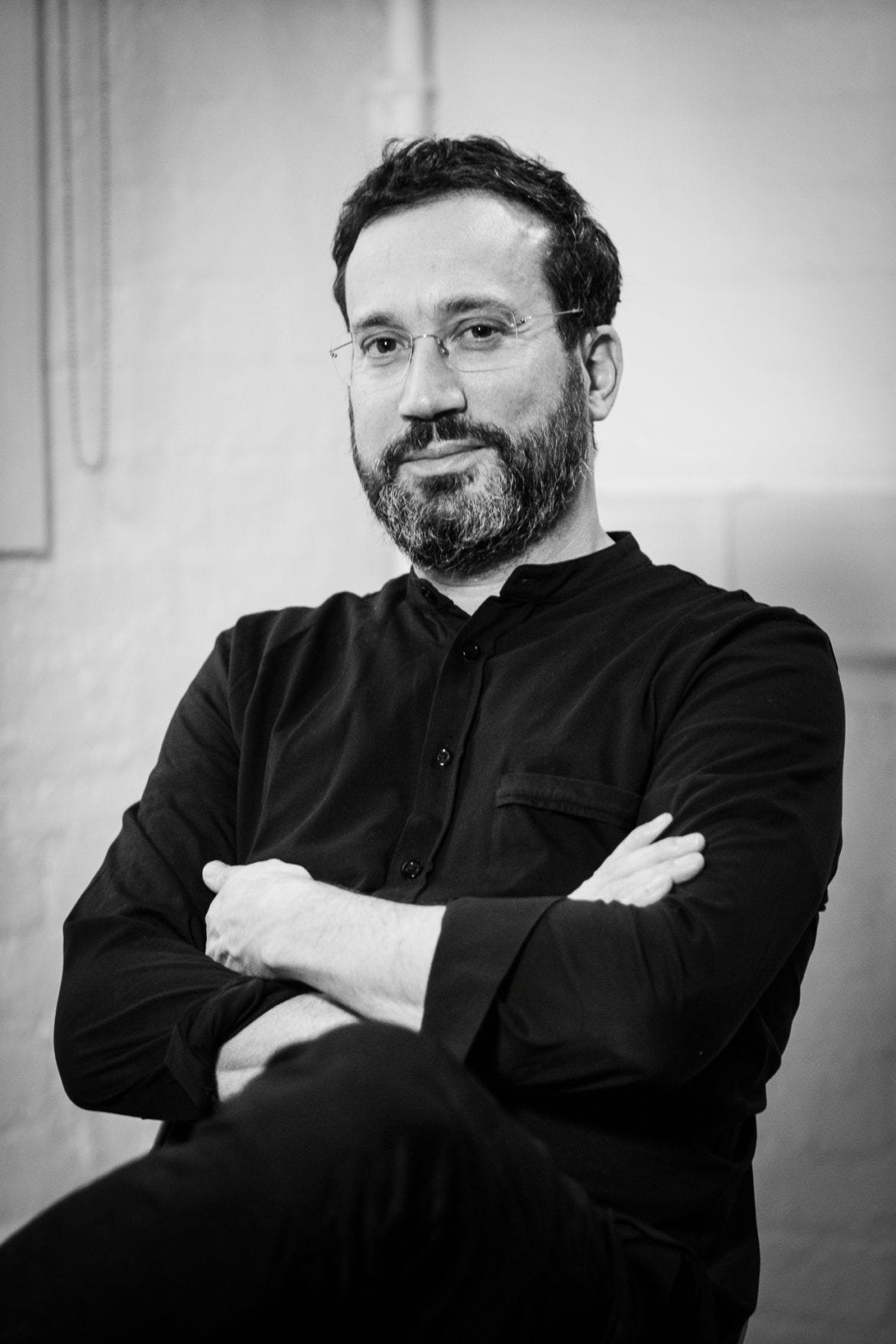
Eyal Weizman is the Founder and Director of Forensic Architecture and professor of Spatial and Visual Cultures at Goldsmiths, University of London, where in 2005 he founded the Centre for Research Architecture. He is the author of Ungrounding: The Architecture of Genocide.
The “Gaza Strip” as a geographic designation did not exist until 1948. The Gaza Strip is a refugee camp. That refugee camp (into which, originally in 1948, 200,000 Palestinians were expelled) has grown tenfold—the population on the eve of October 7th was 2.3 million. The fact that they are refugees means that they have a claim to the land from which they were expelled in 1948, land that has become the state of Israel. The identity of a refugee—the fact that these are refugees—is a questioning of the legitimacy of the state of Israel…Therefore, it is not enough, from an Israeli perspective, to defeat those refugees, but to erase them as refugees.
Eyal Weizman
Israel has unleashed the most lethal and intense aerial campaign in the history of aerial campaigns. Their attempt was to make Palestinians run away into Egypt. They hoped that the border between Palestine and Egypt around the city of Rafah would collapse and Palestinians would end up in the Sinai Desert and then the gates of Palestine would be closed behind them. And they would have solved for themselves, once and for all, the problem of Gaza. But the border held, and people could not be expelled into Egypt. And therefore, [Israel] started a slow campaign, a genocidal campaign, of reengineering the environment in a way that would not allow life.
Eyal Weizman
Caterpillar bulldozers became the most important instrument for that kind of warfare, that kind of genocide that seeks to erase society from place…The Israeli army understands they cannot fight in an urban environment. They cannot engage in urban warfare. In urban warfare, the defenders, the resistance fighters, have the upper hand. They know the alleyways. They understand how to connect between one place or the other. They know how to move through the city and/or refugee camp. The only way that Israel has understood that if they want to uproot Palestinian resistance, they need to destroy the city itself. That is called, in the professional kind of language, “urbicide” (the destruction of a city). And the tool for destruction is the Caterpillar.
Eyal Weizman
If you think about it, buildings are solid toxic waste. You destroy a building, you pulverize it into its material components, and all of the synthetic materials with the first rain seep into the soil and poison it for generations. And it’s one of the paradoxes of Israeli settler colonialism. At the same time that they want to take the [land], they are destroying it. And of course there’s all sorts of systems by which they can cultivate on top of the surface with greenhouses and this and this and that. But in reality, settler colonialism is an ecological catastrophe. Not only Zionist and Israeli settler colonialism, by the way. Settler colonialism is always environmental destruction.
Eyal Weizman
Ralph wants to hear from you! When was the last time you bought anything— a product or a service, based directly on the ad that you read or listened to or saw? We will read and discuss your responses on a future program.

News 11/20/26
Our two opening stories this week come to us from New York City. First up, NYC Mayor Zohran Mamdani announced this week that he is delivering on yet another major campaign promise – disbanding the New York City Police Department’s so-called “Strategic Response Group.” Local activists have long sought the dissolution of the Strategic Response Group (SRG), which has been the main unit deployed against protestors since its creation in 2015, particularly during the 2020 Black Lives Matter uprisings. According to a press release from the Mayor’s Office, issued by Mamdani along with Police Commissioner Jessica Tisch, the SRG will be replaced by a “first-of-its-kind, civilian-led Community Dialogue and De-escalation Division (CDDD) within the Mayor’s Office of Community Safety and…the First Amendment Support Team (FAST), within the department’s Community Affairs Bureau.” Critically, the CDDD will “not have weapons or arrest powers.” This overhaul also includes “new restrictions on the tactics and weapons all officers can use during First Amendment activities, including a formal prohibition on kettling, long guns and tear gas.” Moreover, “Pepper spray will not be used as a crowd-management tool, and long-range acoustic devices will be limited to 90 decibels. Officers will also be prohibited from using bicycles as weapons except when necessary to prevent death or physical injury to themselves or another person.” For her part, Commissioner Tisch added that she “would never support changes that diminish the NYPD’s ability to protect New Yorkers, or that put our officers in a position where they lack the resources necessary to confront a serious threat. These changes will make us a stronger, more effective department.”
Scoring yet another astonishing victory, Mayor Mamdani has secured an “extension of at least 90 days…for the enforcement of a new rule applied to Supplemental Nutrition Assistance Program [SNAP]-authorized retailers across the country,” via direct negotiations with President Trump, per City and State NY. The new SNAP rule “increased the minimum number of staple and perishable foods required for SNAP-authorized stores to provide,” a rule that would fall particularly hard on small businesses like New York City bodegas which rely on SNAP users among their customer base. In a press conference, Mamdani touted that “As a result of this extension, tens of thousands of small businesses across our city and across our nation will now have at least three more months to meet this new guidance. Three more months to procure goods, to establish relationships with purveyors, and to come into compliance.” He also praised Trump for agreeing to extend the deadline for compliance, thereby delivering “relief to small business owners across our city and across America.” The Trump-Mamdani relationship has been among the most unexpected political developments in recent years, but despite Mamdani’s pointed past criticism of the president – notably calling him a “fascist” – the pair have proven able to find common ground and deliver tangible results for the city the president once called home.
Meanwhile, in the nation’s second city, reactionary elements on the Los Angeles City Council are moving to kneecap DSA-backed Mayor-Elect Nithya Raman. First, City Controller Kenneth Mejia reports that the council is attempting to execute a “power grab” via two amendments to the city charter. The first of these would give the Council the power to “fire the Mayor’s General Managers [with] a 2/3rd vote,” and the other would grant the Council the power to “overturn or change the Mayor’s Executive Directives.” Mejia views this is as “the Council…trying to radically change the balance of power in City Hall without any public debate,” and notes that the Council “even has a special Committee that just laid out a year and a half long work plan so they can do ‘a thoughtful, comprehensive, and transparent review of the City’s Charter that allows sufficient time for public engagement and departmental analysis.’” Yet, this vote is being rushed within a week. Los Angeles is already considered to have a ‘weak Mayor’ system of government and because of Measure G passed in 2024, the County of Los Angeles will now elect an executive who will likely have more power than the Mayor beginning in 2028. Finally, the California Post is out with a report on the machinations to fill Raman’s now-vacated seat on the Council prior to the special election. The conservative paper frames this as a progressive plot, but it could just as easily result in the Council appointing a temporary member friendly to the homeowner and developer interests Mayor-Elect Raman will have to confront. Raman herself is calling for a special election to fill the seat as soon as possible.
In Texas, another Democratic executive is taking bold action as well. Governor-Elect Gina Hinojosa, the first Democratic governor elected in the Lone Star State since Anne Richards in 1990, has pledged that once she takes office, she will rescind Governor Greg Abbott’s unconstitutional executive order declaring the Council on American Islamic Relations (CAIR) a “domestic terrorist organization.” CAIR, a Muslim-American civil rights group which defines its mission as helping to “enhance understanding of Islam, protect civil rights, promote justice, and empower American Muslims,” was targeted by outgoing Governor Abbott, as well as disgraced Texas Attorney General Ken Paxton, in a sweeping lawfare campaign directed at Muslim institutions including mosques and private schools. In a statement, CAIR and CAIR Texas wrote “We welcome Texas Governor-Elect Gina Hinojosa’s plan to restore the rule of law in Texas by rescinding this baseless, unconstitutional order targeting our civil rights organization. We encourage all incoming leaders of Texas to end the various attacks that Ken Paxton and other officials launched against the Texas Muslim community, including mosques, private schools, student groups, and even a funeral home…Greg Abbott, Ken Paxton, Bo French, and Mayes Middleton staked their political campaigns on shredding the First Amendment to target Texas Muslims, but the people of Texas rejected this un-American bigotry. Anti-Muslim hate is no longer an effective political weapon in Texas, and it must no longer have any place in state governance.” This announcement comes as Democrats file a flurry of bills in anticipation of taking control of the lower house of the Texas legislature for the first time in decades. These bills include measures to expand Medicaid, raise the minimum wage, cut tax breaks for data centers, legalize marijuana, and ban Flock cameras, per the Texas Tribune.
In news from abroad, massive reforms are under way in Serbia, where a student uprising toppled the country’s longtime, authoritarian leader Aleksandar Vučić. Following two years of anti-corruption protests, the student movement won a resounding victory at the polls, with the so-called Students’ List winning 140 seats in Serbia’s 250-member parliament, per AP. The student movement was spurred by an incident in 2024, when a railway station canopy collapsed killing 16 people. This incident was seen as indicative of widespread corruption within the Serbian government, which is alleged to have deep ties to the Russian government and organized crime syndicates. Another major flashpoint was the $500 million Belgrade hotel project spearheaded by Jared Kushner. In addition to their anti-corruption platform, the students have published a 1,200 page manifesto entitled the Student Plan which lays out a sweeping progressive reform vision which includes everything from labor law reforms to expanding education and healthcare to strengthening civil rights protections for women and the LGBT community. Vučić, who led Serbia as President since 2017 and Prime Minister before then will retain a seat in the parliamentary opposition and while he has promised that his party “won’t carry out any obstruction,” he also vowed that his party will soon stage “protests.” The AP notes he “did not elaborate.”
Elsewhere in Europe, progressive forces are locked in fierce electoral campaigns. In Spain, Pedro Sánchez and his party, the PSOE, are battling to retain power in the country where he has been President for over eight years. His coalition, which includes other left-wing parties along with parties representing Spain’s autonomous regions, is facing off against a coalition made up of the center-right PP and the far-right Vox. As of now, the PSOE and PP are in a dead heat for the number one spot, but Vox is running quite strong in third place, meaning the right may have the numbers to form a government even if the PSOE comes out on top, per POLITICO. This election will be held at the end of November. In Italy, the left coalition is gaining ground, recently winning a by-election in the Chieti constituency, per La Sicilia. If this trend continues, they may be on track to win back control of the government from Giorgia Meloni, whose party – with roots in the post-war neo-Fascist movement – has governed the country since 2022. And in France, the leftist icon Jean-Luc Mélenchon is consolidating the left and seems poised to square off against Marine Le Pen, leader of the far-right National Rally party, in next year’s presidential election. Polls show Le Pen with a substantial lead, but Mélenchon gaining ground as he brings other progressive parties into his camp. Just this week, Marine Tondelier, candidate of the French Green Party announced that she is “ready to form a coalition behind…Mélenchon’s candidacy,” Reuters reports and outgoing President Emmanuel Macron is reportedly saying privately that Mélenchon is “underestimated in opinion polls” and “will likely get a much higher score,” than polls suggest, according to Franceinfo. A new YouGov poll suggests that Le Pen’s support is eroding, dropping by five points against Mélenchon while he gains five. She still enjoys a substantial lead but if this trend continues he could have a fighting chance by the time of the second round of the presidential election in May of 2027.
Turning to Congress, dissident Republican Representative Thomas Massie has announced that he plans to force a War Powers Vote on the Iran War, framing this as offering his colleagues a “lifeboat from MAGA” in the wake of the drubbing they received at the hands of Democrats in the midterm elections, per Newsweek. Massie, who lost his seat to a Trump-backed primary challenger, charged that most of his party is locked in a “suicide pact with this administration.” This accusation certainly carries more weight now that Republicans lost Senate races in usually safe GOP states like Texas, Kansas, Iowa and even Mississippi. A handful of other Republicans have indicated that they might back a War Powers measure, including Tom Barrett, Warren Davidson and Brian Fitzpatrick, all of whom supported a similar measure in September. Massie argues that “This is the best vote [Republicans] can take right now to put some daylight between [themselves] and the failed policy of this war in Iran.” This piece notes that a “Reuters/Ipsos poll conducted November 6-9 found that 51 percent of Republicans supported Congress passing legislation to end the Iran war.”
In the Senate, Maryland’s Chris Van Hollen is waging a fierce uphill fight to wrest the Senate Majority Leader position from Chuck Schumer. In a break from tradition, Van Hollen is taking the leadership fight into the open. “Rather than focusing solely on the inside game of winning over his colleagues, the Maryland senator is mounting a very public bid against…Schumer…[and] could rally many in the party’s base and transform the way these races are fought,” POLITICO reports. According to polling by Data for Progress, this approach is working in turning the public toward Van Hollen, with 43% of Democrats favoring the challenger against 40% for Schumer, and Van Hollen winning Democrat-leaning Independents 53%-23%. Van Hollen has also won the endorsement of National Nurses United, per Democracy Now! According to Drop Site, Schumer holds a lead with 16 Senators leaning towards him while nine lean towards the Van Hollen camp, but 24 remain undecided and 6 have taken no position whatsoever. Either candidate would need 28 votes to win the position.
In the House meanwhile, Hakeem Jeffries easily won his bid to become the first ever Black Speaker. Despite some grumbling, no challenger came forward and Jeffries won with 251 votes in favor and only 11 against. Partly however, this rout is the result of Jeffries making deals with House progressives to move forward their priorities, notably Medicare expansion. NBC reports Jeffries publicly stated that “We should lower the age of Medicare eligibility… expand coverage to include vision, hearing, and dental…And…cover all the kids in the United States of America.” Bernie Sanders sees this as Jeffries “essentially supporting the first year” of Medicare for All, which he said “includes a Medicare eligibility age of 55, plus extending benefits and covering all children.” POLITICO adds that Jeffries shored up support on his left flank by meeting with the Congressional Progressive Caucus executive board to discuss Medicare for All, Israel and other topics. Many hesitant progressives came out of that meeting supporting Jeffries, including Rep. Analilia Mejia. Progressives Darializa Avila Chevalier, Adam Hamawy, Angela Gonzales-Torres, Melat Kiros, Donavan McKinney, Chris Rabb and Claire Valdez were seven of the eleven no votes in the conference, and they issued a joint statement wherein they write that they were elected with a mandate on issues like Medicare for All, stopping ICE terror, ending the genocide in Gaza and getting money out of politics. They add that they have “worked to secure commitments from Leader Jeffries in good-faith conversations” and that they “have seen meaningful progress” but that there “is still work to be done.”
Jeffries however is not the only, or perhaps even the most prominent, figure to join the call for universal healthcare. Pope Leo XIV, the first American Pope, did the same in a recent address to a conference organized by the Council of the Bishops’ Conferences of Europe, the World Health Organization (European Region), and the Italian Episcopal Conference. In this speech, Pope Leo preached that “Universal health coverage is not merely a technical goal to be achieved; it is primarily a moral imperative for societies that wish to call themselves just.” He went on to say that “Health cannot be a luxury for the few,” and that it is “an essential condition for social peace.” The pontiff couched this point in a discussion about the parable of the Good Samaritan and how only together “can we build communities of solidarity capable of caring for everyone, in which wellbeing and peace can flourish for the benefit of all.” This from Vatican News.
This has been Francesco DeSantis, with In Case You Haven’t Heard.


